
Submission process
Healthy City Design 2026 International Congress & Exhibition is a global forum for the exchange of knowledge on the research, policy, investment and practice of designing healthy and sustainable cities and communities.
Why submit an abstract?
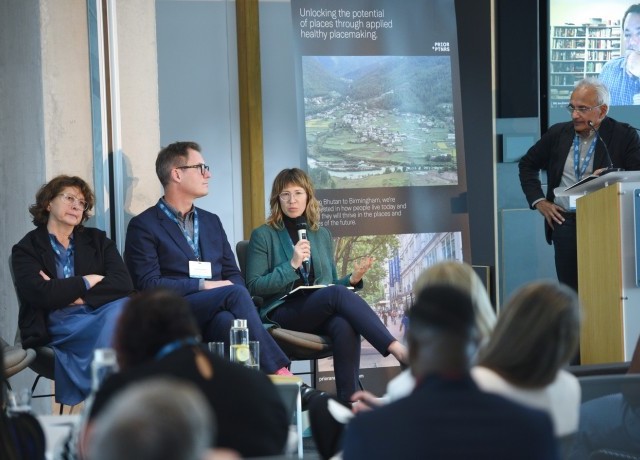
Organised by SALUS Global Knowledge Exchange in partnership with the Helen Hamlyn Centre for Design, Royal College of Art, an international research hub for inclusive design, this year’s Congress will be held at Lowry, MediaCity in Salford, Greater Manchester.
Attendees will develop their knowledge of the political, social and economic context, new policy directions, emerging practice, latest research findings, and skills and core competencies in designing, planning and commissioning city services, technology, infrastructure, impact investment and real estate development that improve people and planetary health.
2026 Themes
How urban planning and design can create healthier, more resilient, and inclusive cities, highlighting global, evidence-based strategies for compact, vibrant, and people-centred urban development that prioritise wellbeing, active living, and community-led regeneration. Including a focused examination of how local planning, design, culture are shaping healthier futures in Salford and Greater Manchester.
How housing and neighbourhood design can support health, equity, and everyday wellbeing, exploring evidence-based approaches to delivering healthy, affordable, and adaptable homes within inclusive, walkable neighbourhoods, addressing issues such as housing quality, density, access to services and green space, and social connection. The stream will showcase policy, design, and community-led initiatives that create safe, resilient places where people can thrive across all stages of life.
How sustainable urban, economic, and social infrastructure, together with green mobility, can support human and planetary health. Grounded in the principles of sustainable development, it will examine how low-carbon, resource-efficient and integrated urban systems enable inclusive economic growth and strengthen social cohesion and community resilience. Topics include active travel, clean energy, nature-based solutions and social infrastructure that help cities thrive within ecological limits.
Examines how urban planning and development can deliver meaningful social value and positive community impact, exploring methods for embedding equity, inclusion, and health outcomes into decision-making, measuring social value, and empowering communities through co-design and local leadership. Case studies will highlight how place-based approaches can strengthen social connection, support regeneration, and ensure that urban change benefits people and communities.
Exploring how digital innovation and smart technologies can improve health, wellbeing, and quality of life in cities. It will examine the role of data, digital tools, and emerging technologies in shaping healthier urban environments – supporting active travel, access to services, environmental monitoring, and more responsive public spaces. It will also address governance, equity, and ethics, highlighting how smart city approaches can be people-centred and inclusive.
How cities can improve health outcomes through place-based approaches, exploring the integration of healthcare provision into communities – at home, in neighbourhood settings, and on the high street – alongside planning and design strategies that support prevention, early intervention, and health equity. Sessions will highlight models that connect health services, housing, and local infrastructure to create accessible, resilient, and people-centred systems of care.
How a wide range of workplaces can be designed, delivered, and managed to support health, wellbeing, and productivity. It will cover commercial real estate and offices, public-sector buildings such as healthcare and education, construction sites, and other non-office workplaces. Sessions will highlight evidence-based design and policy approaches that improve physical and mental health, safety, inclusion, and sustainability across diverse working environments.
Authors are invited to submit abstracts of 400 words in English for in-person presentation in the following formats: a) themed paper; b) video+poster; c) workshop. The abstract should clearly state the background, purpose, methods, results and conclusions/implications.
Presentations in all formats can be focused on research, practice or policy. For full abstract guidelines and the submission form, visit www.healthycitydesign.global.
Each presentation will be delivered to an interdisciplinary audience. All abstracts will be subject to a rigorous blind peer-review process by the HCD 2026 programme committee. A select number will be chosen for oral presentation with a wider number presented
as videos + posters. Proposals must be submitted using the abstract proposal form and MUST include the following:
a) presentation type (themed paper, poster or workshop);
b) knowledge focus (research, practice or policy);
c) congress theme (plenary or stream);
d) title, author(s), organisational affiliation and three learning objectives.
Abstracts of the papers selected for presentation will be published online. Please note: the author(s) and/or co-author(s) are required to register and pay the registration fee to participate and present the paper at the Congress. All speakers are expected to participate ‘in person’.
Who should submit a paper and attend?
The Healthy City Design 2026 International Congress & Exhibition attracts the world’s leading interdisciplinary policy thinkers, researchers and practitioners.
The Congress will be of interest to:
| • City governance and policymakers | • Occupational therapists |
| • Community leaders and voices | • Institutional investors |
| • Urban designers and planners | • Business leaders |
| • Public health practitioners | • Technology leaders |
| • Commercial property developers | • Real estate investors |
| • Health and social care planners | • Senior public servants |
| • Sustainability and ESG practitioners | • Environmental groups |
| • Academics and researchers | • Architects and engineers |
| • Economists and social scientist | • Housing developers |