HCD2026 Awards: Winners revealed
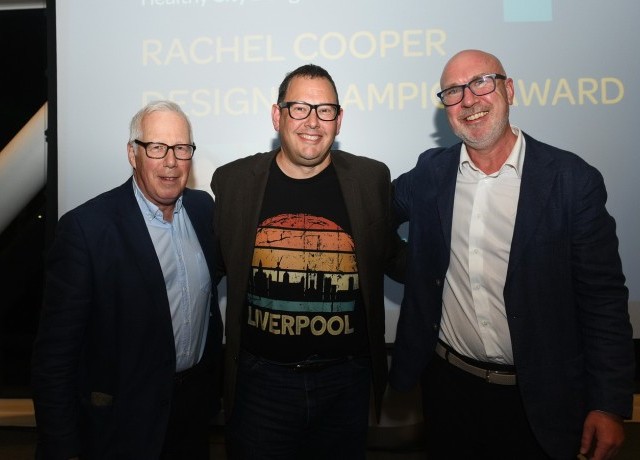
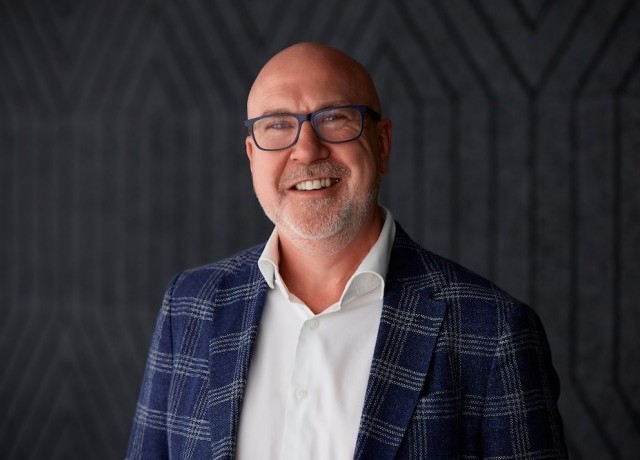
Matthew Ashton, director of public health for Liverpool City Council, has been named this year’s Rachel Cooper Design Champion at the Healthy City Design 2026 Awards, recognising his contribution to advancing public health and the role of place in improving people’s lives.
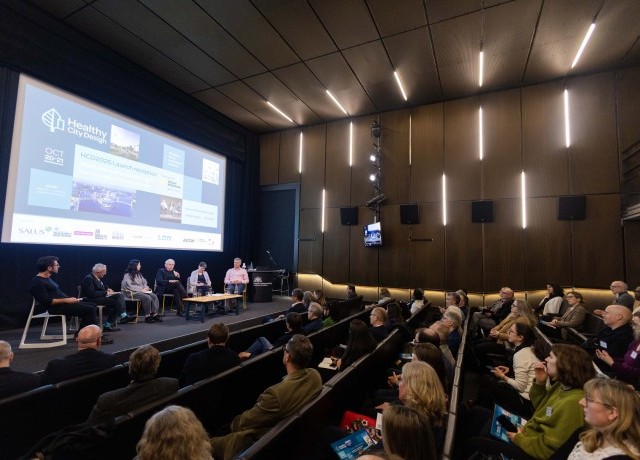
The prestigious individual award was the highlight of an evening celebrating innovation and excellence in the planning, design and development of healthier cities and communities. The ceremony, held at Old Trafford Football Stadium, on Tuesday 20 October, brought together professionals from across public health, architecture, urban planning, research and the built environment to recognise projects making a difference to human health, wellbeing and planetary health.
Now in its tenth year, the Healthy City Design Congress has become a meeting point for those working to put health at the heart of how places are planned, designed and developed. This year’s Awards recognised achievement across seven categories, covering everything from urban regeneration and housing to green infrastructure, community-led design, healthcare environments and research into the relationship between cities and health.
Ashton received the Rachel Cooper Design Champion Award, which honours an individual whose work has helped advance the field of healthy cities. Named in memory of the late Professor Rachel Cooper, the award recognises the importance of leadership and advocacy in bringing health and design closer together.
The project awards, meanwhile, demonstrated the breadth of work taking place in the UK and internationally to create places that support healthier lives, stronger communities and more sustainable futures.
Celebrating healthier places
In the ‘Healthy city design and planning’ category, supported by Urban Initiatives, the winner was Stockton Urban Park and Waterfront, commissioned by Stockton-on-Tees Borough Council and designed by Ryder Architecture.
The project was recognised in a category celebrating people-centred urban planning and design, and the role of regeneration in shaping healthier, more resilient and inclusive cities. The award highlights the importance of bringing together evidence, local context and thoughtful design to create urban environments that encourage active living and improve everyday experiences of place.
The award for ‘Healthy homes and neighbourhoods’, supported by AECOM, went to Sutton Estate Regeneration, commissioned by Clarion Housing Group and designed by Civic and HTA Design.
Housing is fundamental to health and wellbeing, and the category recognises projects that look beyond individual buildings to consider the wider neighbourhood. Access to services, green space, walkable streets and opportunities for social connection all contribute to healthier communities. Sutton Estate Regeneration was selected from a shortlist demonstrating different approaches to creating inclusive and supportive places to live.
In ‘Sustainable infrastructure and green mobility’, the winning project was Grosvenor Square, commissioned by Grosvenor and designed by Tonkin Liu and BDP.
The category celebrates projects that bring together sustainable infrastructure, inclusive mobility and environmental responsibility. By recognising work in this field, the Awards underline the connections between the quality of our surroundings, opportunities for active lifestyles, environmental resilience and the health of both people and the planet.
The ‘Community impact and social value’ award went to The New Story Garden, delivered by Global Generation and Jan Kattein Architects.
This category focuses on the social benefits that can emerge when development responds to community needs and puts inclusion at the centre of decision-making. It recognises the value of engagement, collaboration and co-design in creating places that people can connect with and benefit from over the long term. The New Story Garden was selected from a shortlist that also included community-focused projects and public spaces designed to strengthen local connections.
In ‘Population and neighbourhood health’, the winner was New Betio Hospital (Stage 1), commissioned by the Ministry of Health and Medical Services, Republic of Kiribati, and designed by Jacobs.
The award recognises approaches that connect healthcare with the wider places and communities it serves. It highlights the importance of accessible, resilient and people-centred systems of care, alongside planning and design that support prevention, early intervention and health equity. New Betio Hospital (Stage 1) was recognised in a category that also featured projects integrating healthcare, education and community infrastructure.
The ‘Healthy working environments’ award went to Midland Metropolitan Learning Campus, commissioned by Sandwell & West Birmingham NHS Trust and designed by Hawkins\Brown.
Workplaces and learning environments play an important part in everyday wellbeing. This category recognises design that supports physical and mental health, safety, inclusion and productivity, while also considering sustainability. Midland Metropolitan Learning Campus stood out among a shortlist of projects exploring how the design and management of working environments can better support the people who use them.
Finally, the ‘Design research for healthy cities’ award went to the research paper ‘Hidden Vulnerability and Heat-Triggered Decompensation: Rethinking Urban Overheating Beyond Clinical Risk’, led by Mingyu Zhu at the University of Glasgow, with co-authors Qunshan Zhao, University of Glasgow, and Jiayi Jin, Northumbria University.
The research category celebrates work that advances understanding of how the built environment affects health, equity and wellbeing, and that can inform future design, policy and practice. The winning paper’s focus on urban overheating and vulnerability brings attention to the need to consider how heat affects people whose risks may not be fully captured by conventional clinical assessments. As cities confront rising temperatures and more frequent extreme heat, such research can help broaden the understanding of who is at risk and how urban environments might respond.
Recognising a decade of healthy city design
The 2026 Awards took place at the Evolution Suite at Old Trafford, home of Manchester United Football Club, against the backdrop of wider regeneration ambitions for the Trafford Wharfside area. Plans for new homes, workplaces, public spaces, transport links and community facilities underline the opportunity to make health and wellbeing central to urban transformation.
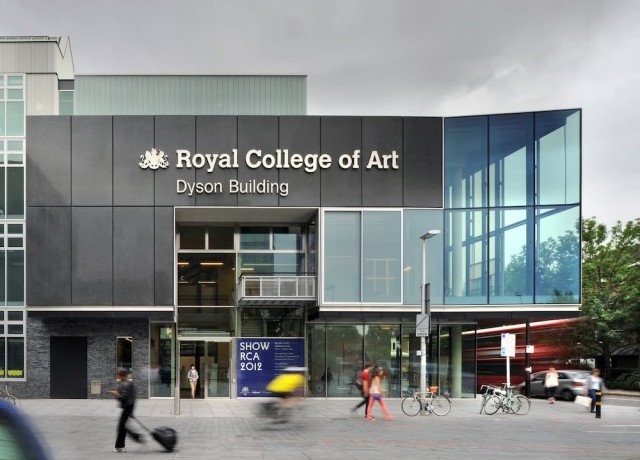
Organised by SALUS Global Knowledge Exchange and the Helen Hamlyn Centre for Design at the Royal College of Art, the Healthy City Design Congress has spent a decade bringing together people from different disciplines to share ideas, evidence and practical approaches to healthier urban futures.
The evening also included a special tenth-anniversary honour for Marc Sansom, founder of SALUS and co-organiser of the Healthy City Design Congress. Presented by Max Farrell, the new chair of the Congress, the award recognised Marc’s dedication and commitment to promoting the field of healthy cities design over a decade since the Congress was conceived.
As the Congress marks its tenth anniversary, this year’s winners reflect the breadth of work needed to create healthier places — from the scale of the city and neighbourhood to individual buildings, community spaces and the research that helps shape future practice.
HCD2026 Awards: Full results and judging panels
The following list records the category winners, other shortlisted entries and the published judging panels.
Rachel Cooper Design Champion Award
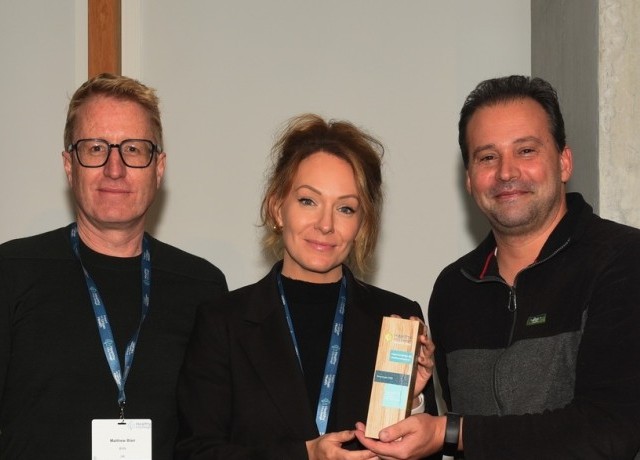
Winner: Matthew Ashton, director of public health, Liverpool City Council (pictured above, centre)
Healthy city design and planning
(Supported by Urban Initiatives)
Winner: Stockton Urban Park and Waterfront
Commissioned by Stockton-on-Tees Borough Council
Designed by Ryder Architecture
Highly commended
BaptistCare Masterplan — commissioned by BaptistCare; designed by BVN
Heart Of The City II, Sheffield — commissioned by Sheffield City Council; designed by Feilden Clegg Bradley Studios
Judging panel
Lead judge: Sunand Prasad OBE, PPRIBA, Perkins&Will, UK
Panel judges: Hugo Nowell, Urban Initiatives, UK
Natalia Uribe, BDP, UK
Healthy homes and neighbourhoods
(Supported by AECOM)
Winner: Sutton Estate Regeneration
Commissioned by Clarion Housing Group
Designed by Civic and HTA Design
Highly commended
BaptistCare Masterplan — commissioned by BaptistCare; designed by BVN
Kidbrooke Park Road North — commissioned by the Royal Borough of Greenwich and Greenwich Builds; designed by HTA Design
Judging panel
Lead judge: Ben Cave, BCA; University of Groningen, UK
Panel judges: Cathy Russell, Ryder Architecture, UK
Heather Macey, Makower Architects, UK
Sustainable infrastructure and green mobility
Winner: Grosvenor Square
Commissioned by Grosvenor
Designed by Tonkin Liu and BDP
Highly commended
New Betio Hospital (Stage 1) — commissioned by the Ministry of Health and Medical Services, Republic of Kiribati; designed by Jacobs
Judging panel
Lead judge: Louise Ciotti, University of the West of England, UK
Panel judges: Robert Delius, Stride Treglown, UK
Anna Rose, Space Syntax, UK
Community impact and social value
Winner: The New Story Garden
Delivered by Global Generation and Jan Kattein Architects
Highly commended
Helston Gateway — commissioned by South Kerrier Alliance CIC; designed by MJ Medical
Horatio’s Garden Sheffield & East — commissioned by Horatio’s Garden; designed by Harris Bugg Studio
Yarrila Place — commissioned by Coffs Harbour City Council; designed by BVN
Judging panel
Lead judge: Lourdes Madigasekera-Elliott, East Sussex County Council, UK
Panel judges: Mark Drane, Urban Habitats, UK
Ernst ter Horst, MCAU, UK
Population and neighbourhood health
Winner: New Betio Hospital (Stage 1)
Commissioned by the Ministry of Health and Medical Services, Republic of Kiribati
Designed by Jacobs
Highly commended
BaptistCare Masterplan — commissioned by BaptistCare; designed by BVN
Midland Metropolitan Learning Campus — commissioned by Sandwell & West Birmingham NHS Trust; designed by Hawkins\Brown
Parkhead Hub — commissioned by NHS Greater Glasgow & Clyde; designed by Hoskins Architects; engineered by AECOM
Judging panel
Lead judge: Beatrice Fraenkel, Design Council, UK
Panel judges: Victoria Head, Archus, UK
Kerry Harding, Mott MacDonald, UK
Healthy working environments
Winner: Midland Metropolitan Learning Campus
Commissioned by Sandwell & West Birmingham NHS Trust
Designed by Hawkins\Brown
Highly commended
NESO Energy Lab, Faraday House — commissioned by NESO; designed by AECOM
No 1. St Michael’s — commissioned by Relentless Developments / KKR; designed by Hodder Architects
Judging panel
Lead judge: Jeremy Myerson, The Helen Hamlyn Centre for Design, Royal College of Art, UK
Panel judges: Esme Banks Marr, BVN, UK
Mark Eltringham, Insight Publishing, UK
Design research for healthy cities
Winner: Hidden Vulnerability and Heat-Triggered Decompensation: Rethinking Urban Overheating Beyond Clinical Risk
Lead author: Mingyu Zhu, University of Glasgow
Co-authors: Qunshan Zhao, University of Glasgow; Jiayi Jin, Northumbria University
Highly commended
Dede is Autistic – Designing for Neurodiversity — lead author: Rebecca Jilks, University of Sheffield
Designing Health Through Partnership: The Connswater Community Greenway as a Living Laboratory for Healthy City Design Research — lead author: Ruth Hunter, Queen’s University Belfast
Building for a Healthy Life 2026 edition — lead authors: David Birkbeck, Design for Homes, and Stefan Kruczkowski, the Urban Design Doctor
Judging panel
Lead judge: Helen Pineo, University of Washington, USA
Panel judges: Garrett Sansom, Texas A&M Health, USA
Chris McGinley, Royal College of Art, UK
Andy Miah, University of Salford, UK
Special tenth-anniversary award
Marc Sansom, founder and managing director of SALUS and co-organiser of the Healthy City Design Congress, was honoured for his dedication and commitment to promoting the field of healthy cities design. The award was presented by Max Farrell, the new chair of the Congress.
Event news

Actions to improve urban renewal and health equity
2nd September 2024
A vision for Liverpool: Putting people’s health first
2nd September 2024
Investing in urban renewal and health equity
21st March 2024
Health equity: Marmot Cities
20th March 2024